

Lei is a multidisciplinary, multimedia fashion textiles based artist. Lei has experienced diverse cultures that influenced her to create narrative and conceptual fashion textiles pieces.
Her focus is to create fashion and textile pieces that challenge gender boundaries and celebrate the malleability of gender identities. She is currently working on her graduate collection ‘No-Land’ depicts a underwater scenario in a hypothetical future universe.
Human civilisation was born in the ocean. Science research shows that all lives including human were originated from the ocean. The future of human being would be closely related to the ocean as well.
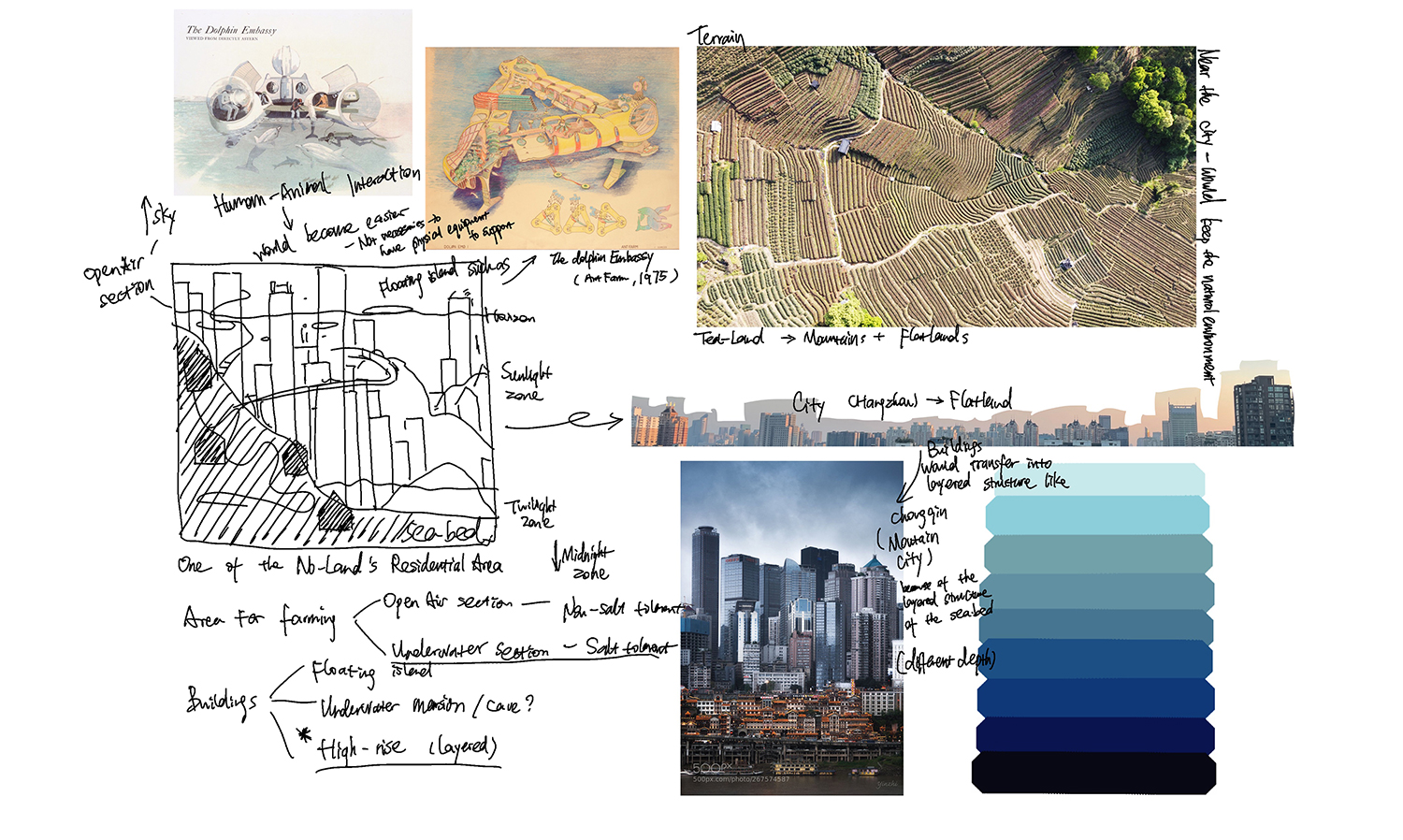
In the year of 2223, the evolved humans are starting to build ‘No-Land’, a hypothetical underwater residential area in a parallel universe, sets at the situation of the disappearance of land, where the sea and sky merged together.

Lei is designing characters and their performative fashion textiles collection in her experimental way of both physical and digital forms, towards a scenario illustrates the combination of the future vision of a underwater world and evolved human civilization. She used self-tanned fish skin for her initial material development to simulate the texture and marine animals’ regulation of colour change underwater.

The exploration of material starts from the most common marine animal, fish. As human civilization starts from the ocean, moving into No-land means we are back to the beginning. The initial evolution of life was that all creatures on the planet are followed a basic genetic framework. We have a common ancestor, which led to the similarity of the biological genes on our planet to such a high level. Fish has the largest number of spinal animals in the world, which could be seen as an ancestor of humans. In No-Land, the evolved human being could be much closer to a fish. Other materials would also be hypothetically included in Lei’s character designing processes, such as metal that absorb extra sodium contents to help the human body create a salt gland.
Colour plays a crucial part in ‘No-land’, the marine animals change their colours to camouflage themselves or warn others. The collection depicts the marine animals’ regular pattern of colouration as well as the lighting environment of the sea which are gradually changing depending on depth.

